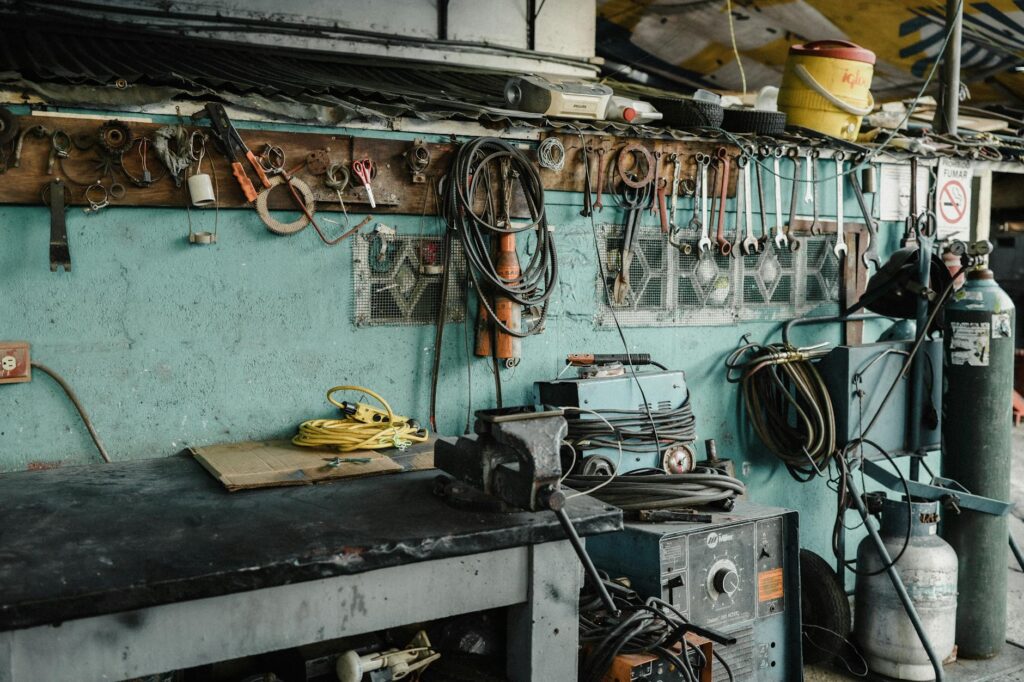
Planning your workshop electrical system requires careful consideration of power demands, circuit capacity, and safety standards. A properly designed circuit layout ensures your tools and compressors run efficiently without tripping breakers or creating fire hazards. This guide walks you through the essential steps to create a reliable workshop electrical infrastructure.
Understanding Your Workshop Power Demands
Before installing a single outlet, you need to calculate the total electrical load your workshop will handle. This starts with identifying every tool and piece of equipment you’ll use, then determining each device’s wattage and startup current requirements.
Air compressors are among the most demanding workshop loads. A typical 2-3 horsepower compressor draws 12-16 amps continuously, but the motor draws 2-3 times more current during startup. Stationary tools like table saws, band saws, and drill presses each require dedicated circuits to prevent voltage drops that reduce performance and damage motor windings.
Hand tools and portable devices have lower demands but shouldn’t share circuits with high-draw equipment. Create an inventory listing:
- Air compressor: 15-20 amps
- Table saw: 12-15 amps
- Dust collector: 8-12 amps
- Shop vacuum: 10-12 amps
- General outlets for hand tools: 6-8 amps per circuit
Each item should have its maximum amperage documented from the manufacturer’s nameplate. Add up your total continuous load, then add 25% for future expansion. This total determines your service entrance capacity and feeder wire size.
Designing Dedicated Circuits for High-Draw Equipment
The National Electrical Code (NEC) requires specific circuit designs based on equipment classification. Motor-driven tools need special consideration because induction motors have high inrush currents during startup.
For your air compressor, use a dedicated 20-amp circuit minimum with 12-gauge wire and a tandem or double-pole breaker. Some larger compressors require 30-amp circuits with 10-gauge wire. Never plug a compressor into a standard outlet circuit—the voltage drop will damage the motor and trigger frequent breaker trips.
A dust collector serving your entire workshop also deserves its own circuit. These motors typically run 5-10 horsepower and draw sustained current, making them unsuitable for shared circuits. Wire the circuit generously; undersized conductors create heat buildup that shortens motor life.
Table saws and similar stationary power tools should each have dedicated 20-amp circuits with 12-gauge wire. If you’re installing a panel upgrade to accommodate multiple large tools, consider running separate 240-volt circuits for the heaviest loads. A 240-volt circuit provides more power capacity and better voltage stability than 120-volt equivalents.
Position outlets strategically around your workshop so equipment sits within 6 feet of a dedicated outlet. Avoid extension cords for permanent equipment—they create voltage drop, fire hazards, and tripping hazards.
Workshop Layout and Outlet Placement Strategy
Effective workshop planning considers both current needs and future expansion. Zone your workshop into stations: a wood turning area, a metalworking station, a finishing area, and a compressor/pneumatic section.
Your compressor should sit in a separate zone, ideally away from work areas, because it generates noise and vibration. Run the 20-30 amp circuit to a heavy-duty outlet near the compressor location. Mount the outlet on a weatherproof plate with a grounded receptacle rated for the circuit amperage.
Stationary tools work best when located against perimeter walls where you can dedicate wall-mounted circuits. Install outlets 12-18 inches above the workbench height for convenience and safety. Mount all outlets with faceplate covers to prevent sawdust and debris intrusion.
General-purpose circuits for hand tools and chargers can be installed in rows along walls, spacing outlets every 6 feet maximum. Use outlets with ground fault circuit interrupter (GFCI) protection on circuits within 6 feet of sinks or water sources. This prevents electrocution hazards in damp environments.
Plan for at least one 20-amp general-purpose circuit dedicated to equipment charging and small devices. This prevents nuisance tripping when someone plugs in a battery charger while a tool is running on another circuit.
Label every outlet and circuit clearly. Create a circuit directory posted near your breaker panel showing which outlets and equipment connect to each breaker. This saves troubleshooting time and helps you balance loads across available circuits.
How to Use the Electrical Load Calculator
Calculating your workshop’s electrical requirements precisely ensures you size circuits and feeder wire correctly. The electrical load calculator helps you determine total demand and verify circuit capacities before installation begins. Enter the wattage and quantity of each tool, and the calculator instantly shows your total load, recommended breaker sizes, and wire gauge requirements.
Frequently Asked Questions
Can I use a power strip or extension cord for my air compressor?
No. Air compressors must connect directly to a dedicated circuit with a proper outlet. Power strips and extension cords aren’t designed for the sustained current and inrush loads that motor-driven equipment demands. Using them risks fire, equipment damage, and breaker failure. Always install a permanent, dedicated outlet wired with properly sized conductors.
How many amps do I need for a typical home workshop?
Most home workshops benefit from a 100-amp subpanel with at least 6 dedicated circuits: one for the compressor (20-30 amps), one each for large stationary tools (20 amps), one for the dust collector (20 amps), and two general-purpose circuits (20 amps each) for hand tools and accessories. If you plan to run multiple tools simultaneously, increase this to an additional 200-amp service.
Should my workshop circuits be 120-volt or 240-volt?
Use 240-volt circuits for high-draw equipment like air compressors, table saws, and dust collectors. They deliver more power, reduce voltage drop over distance, and improve motor efficiency. Keep 120-volt circuits for hand tools, chargers, and lighting. Many modern workshops use both: 240-volt for major equipment and 120-volt for general work.
- Kill A Watt Electricity Usage Monitor — Helps workshop owners measure actual power consumption of tools and compressors to plan circuits accurately and avoid overloading
- Square D Homeline Circuit Breaker Panel — Essential equipment for implementing proper circuit design and protection as discussed in workshop electrical planning
- 12-Gauge Electrical Wire and Breaker Kit — Directly supports the installation of dedicated circuits for high-demand workshop tools and air compressors mentioned in the guide
SPONSORED
Estimating Software Built for Electrical Contractors
ArcSite lets you draw site plans, create estimates, and close jobs faster — all from your phone or tablet. Used by 100,000+ field service professionals.
Try ArcSite Free →Affiliate partner — we may earn a commission at no cost to you.