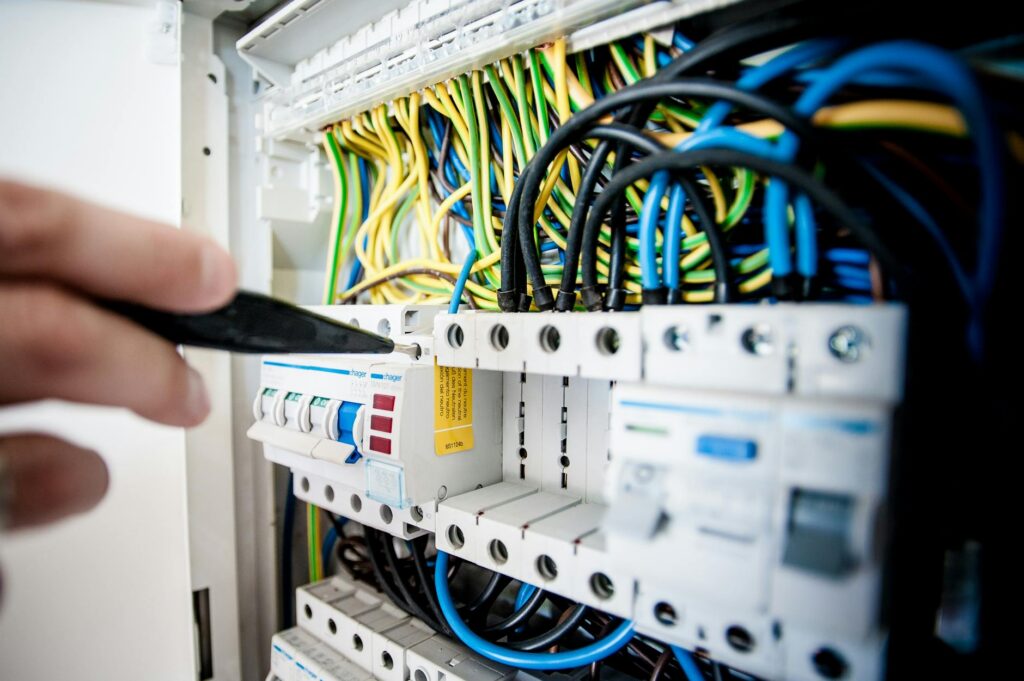
Circuit Breaker Sizing: Calculate Amperage for Any Load
Circuit breaker sizing is a critical safety calculation that determines whether your electrical system can handle specific appliances and devices. To properly size a circuit breaker, you must calculate the total amperage draw of all loads on that circuit and select a breaker rated at least 125% of that continuous load amperage. This guide walks you through the exact formulas and methods electricians use every day.
Understanding Amperage and Load Requirements
Before you can size a circuit breaker, you need to understand what amperage actually means and how it relates to electrical loads. Amperage (measured in amps) represents the flow of electrical current through a conductor. Every electrical device has a nameplate that lists its required amperage or wattage.
If your device only lists wattage, you’ll need to convert it to amperage using Ohm’s Law. For single-phase systems, the formula is: Amps = Watts ÷ Volts. For example, a 1,200-watt space heater on a 120-volt circuit requires 10 amps (1,200 ÷ 120 = 10).
Different types of loads have different requirements. Continuous loads (like water heaters or HVAC systems running longer than three hours) require the circuit breaker to be sized at 125% of the actual load. Non-continuous loads (like a microwave or dishwasher that run for short periods) can be sized at 100% of their nameplate amperage.
The National Electrical Code (NEC) requires that circuit conductors and protective devices be sized appropriately to prevent overheating and potential fire hazards. This is why proper calculations aren’t just recommended—they’re mandatory in every jurisdiction.
Step-by-Step Calculation Method
Follow these steps to calculate the correct circuit breaker size for any load:
Step 1: List All Loads – Write down every appliance, light fixture, or device that will be connected to the circuit. Include the nameplate amperage or wattage for each item.
Step 2: Convert Watts to Amps (if necessary) – Use the formula Amps = Watts ÷ Volts for single-phase loads, or Amps = Watts ÷ (Volts × 1.732) for three-phase loads. Most residential applications are single-phase at 120V or 240V.
Step 3: Sum the Amperage – Add up all individual amp requirements to get the total circuit amperage. For example, if you have three devices drawing 5 amps, 7 amps, and 6 amps respectively, your total is 18 amps.
Step 4: Apply the 125% Rule for Continuous Loads – If any loads are continuous (operating for more than three hours), multiply that portion of the load by 1.25. Using our example: if 12 of those 18 amps are continuous, multiply 12 × 1.25 = 15 amps. Then add the non-continuous loads: 15 + 6 = 21 amps total.
Step 5: Round Up to Standard Breaker Size – Circuit breakers come in standard sizes: 15, 20, 30, 40, 50, 60, 70, 80, 100, 125, 150, 175, 200 amps and beyond. Always round up to the next standard size. In our example, you’d need a 25-amp breaker (though 20-amp is the next standard size below 21, you must round up to 25 or higher to safely accommodate the load). Actually, since 25 isn’t standard, you’d select a 30-amp breaker.
Common Circuit Breaker Sizing Scenarios
Kitchen Circuits: Kitchen circuits typically handle dishwashers, garbage disposals, and countertop appliances. Most kitchen circuits are 20 amps at 120 volts. However, any single large appliance like a range or oven requires its own dedicated circuit, often 40-50 amps at 240 volts, depending on the appliance’s nameplate amperage.
Bathroom Circuits: Bathrooms need at least one 20-amp circuit dedicated to receptacles (per NEC code). If you’re adding a heated floor mat or towel warmer, verify its amperage and ensure the circuit can accommodate it. Most bathroom circuits are standard 20-amp breakers.
HVAC Systems: Air conditioning and heating systems are continuous loads. If your AC unit requires 30 amps, you must size the breaker at 30 × 1.25 = 37.5 amps, which rounds up to a 40-amp breaker. Always consult the unit’s documentation for minimum circuit ampacity requirements.
Electric Vehicle Charging: EV chargers are among the largest continuous loads in modern homes, often requiring 40-60 amps at 240 volts. These absolutely must have their own dedicated circuit with proper sizing, usually a 50 or 60-amp breaker depending on the charger model.
Dedicated Appliance Circuits: Refrigerators, washing machines, and other large appliances need dedicated circuits. Check the nameplate amperage and apply the 125% rule if it’s a continuous load. Most homes use 20-amp circuits for these applications.
How to Use the Circuit Amperage Calculator
While these calculations are straightforward, you can save time and eliminate errors by using our circuit breaker amperage calculator. Simply enter your device wattage or amperage, specify whether each load is continuous or non-continuous, and the calculator instantly provides your required breaker size. This tool automatically applies the 125% rule and rounds to standard breaker sizes, ensuring your design meets NEC requirements.
FAQ: Circuit Breaker Sizing
Can I use a larger circuit breaker to prevent nuisance trips?
No. Using an oversized breaker defeats its safety purpose. Circuit breakers protect the wire from overheating and causing fires. If a breaker is too large for the wire gauge, dangerous amperage can flow through undersized conductors without triggering the breaker. Always match your breaker size to both the load requirements AND the wire gauge used in the circuit.
What’s the difference between a 20-amp and 30-amp breaker?
A 20-amp breaker trips when continuous current exceeds 20 amps, while a 30-amp breaker permits up to 30 amps. They’re also designed for different wire gauges: 20-amp breakers typically use 12 AWG wire, while 30-amp breakers use 10 AWG wire. Using a 30-amp breaker on 12 AWG wire creates a fire hazard because the breaker won’t trip until the wire is dangerously hot.
Do I need a sub-panel if my main panel has no space?
If your main panel is at capacity and you need additional circuits, a sub-panel is a good solution. However, installation requires proper sizing of the feeder wire and a disconnect switch. This is specialized work that should be performed by a licensed electrician to ensure code compliance and safety.
Related: wire gauge calculator sizing
Related: low-voltage rough-in planning
Related: arc fault breaker tripping issues
Related: add circuit to electrical panel
Related: amperage calculator guide
Related: wire size calculator guide
Related: voltage drop calculator
Related: wire gauge calculator guide
Related: whole home surge protector installation
Related: workshop circuit planning guide
Related: electrical permit requirements guide
Related: voltage drop calculator guide
Related: voltage drop calculator
Related: wire gauge calculator guide
Related: 3-way switch wiring installation
Related: solar panel wiring voltage drop
- Digital Clamp Meter – INNOVA 3340 — Essential tool for measuring actual amperage draw of loads, directly supporting circuit breaker sizing calculations and troubleshooting
- Electrical Load Calculator / Amp Calculator Device — Practical device that helps users calculate amperage requirements for their specific appliances and circuits
- Circuit Breaker Finder and Tracer Kit — Helps identify which circuit breaker controls specific loads, essential for proper circuit sizing and electrical system management
SPONSORED
Estimating Software Built for Electrical Contractors
ArcSite lets you draw site plans, create estimates, and close jobs faster — all from your phone or tablet. Used by 100,000+ field service professionals.
Try ArcSite Free →Affiliate partner — we may earn a commission at no cost to you.