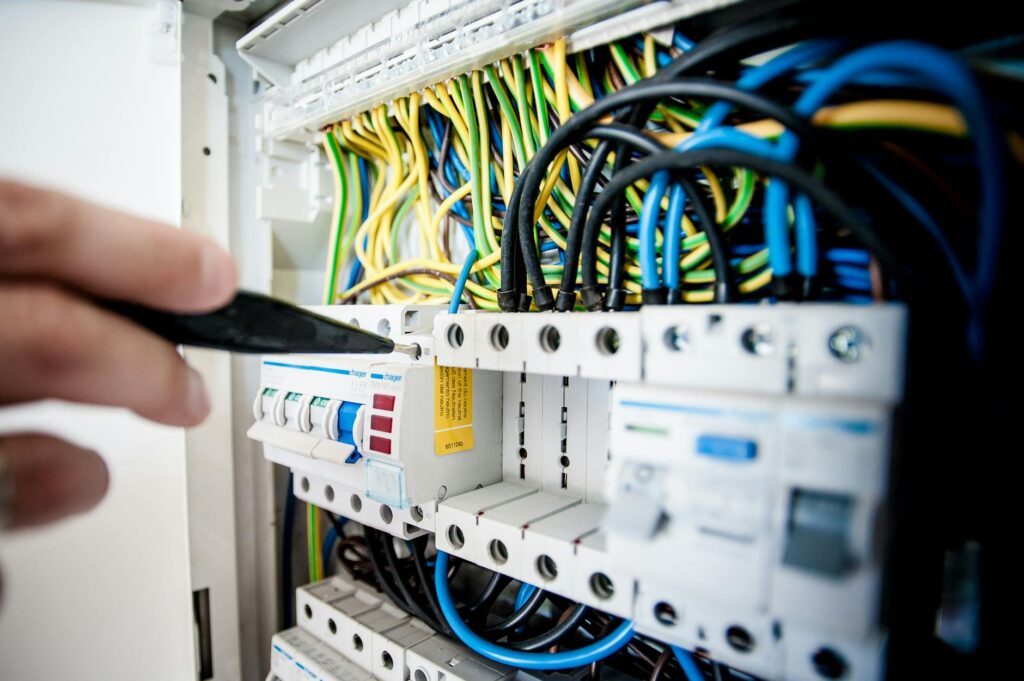
Proper circuit breaker sizing is essential for electrical safety and system performance. The correct breaker size protects your wiring from overheating while ensuring your appliances and devices receive adequate power. This guide walks you through calculating the exact amperage your circuit needs.
Understanding Circuit Breaker Basics
A circuit breaker is an automatic switch that interrupts electrical flow when current exceeds a safe level. The breaker’s amperage rating must match your circuit’s actual load requirements while protecting the wire gauge you’re using. Undersizing causes nuisance tripping; oversizing risks wire damage and fire hazards.
Circuit breakers come in standard sizes: 15A, 20A, 30A, 50A, 60A, 100A, and larger. Each rating corresponds to specific wire gauges. For example, 14-gauge wire requires a maximum 15A breaker, while 12-gauge supports up to 20A, and 10-gauge handles 30A.
The National Electrical Code (NEC) establishes these requirements to prevent overheating. Your breaker protects the weakest link in the circuit—typically the wire. If a breaker is too large for the wire gauge, the wire overheats before the breaker trips, creating fire risk.
Calculating Your Circuit’s Amperage Requirements
Start by identifying all devices and appliances on your circuit. Add up their individual current draws, typically listed on device nameplates or in the manual. For example:
- LED light fixture: 0.5A
- Desktop computer: 2.5A
- Desk lamp: 0.8A
- Phone charger: 0.3A
Total: 4.1A combined load. In this case, a 15A breaker is appropriate.
For appliances rated in watts rather than amps, use the formula: Amps = Watts ÷ Volts. A 1200-watt space heater on a 120V circuit draws 10A (1200 ÷ 120 = 10A).
The NEC also requires you to apply a 125% safety factor to continuous loads (those running three hours or longer). Multiply the calculated amperage by 1.25, then round up to the next standard breaker size. A 16A load (20A × 1.25) requires a 20A breaker.
This 125% continuous load factor is codified in the NEC 80% rule, which governs every breaker in your panel. For a complete breakdown of how the rule applies to continuous vs. non-continuous loads, 100-amp vs. 200-amp panels, and common code violations, see our guide: NEC 80% Rule Explained.
For three-phase systems and large industrial loads, calculations become more complex. You’ll need to account for power factor and diversity factors. Always consult a professional electrician for commercial installations.
Wire Gauge and Breaker Size Coordination
Your wire gauge and breaker size must work together. Here’s the standard coordination chart:
- 14 AWG wire: 15A breaker maximum
- 12 AWG wire: 20A breaker maximum
- 10 AWG wire: 30A breaker maximum
- 8 AWG wire: 40-50A breaker
- 6 AWG wire: 60A breaker
- 4 AWG wire: 100A breaker
Never install a breaker larger than the wire gauge allows. If your load calculation shows you need a 30A breaker but you only have 12-gauge wiring, you must upgrade to 10-gauge wire first.
When in doubt about wire sizing, consult the NEC Article 310 tables. These tables account for temperature derating when wires run in conduit or hot environments. Underground cables, attic installations, and conduit fill all affect safe ampacity ratings.
How to Use Our Circuit Breaker Calculator
Manual calculations work fine for simple circuits, but our circuit breaker sizing calculator saves time and reduces errors. Enter your individual load values, and the calculator automatically applies the 125% safety factor, accounts for wire gauge limitations, and recommends the appropriate breaker size.
Simply input your appliances’ wattage or amperage, select your wire gauge, and the calculator provides instant results. This tool is particularly helpful for designers, electricians, and homeowners planning panel upgrades or new circuits.
Common Circuit Breaker Sizing Scenarios
Kitchen Countertop Outlets: The NEC requires a minimum 20A circuit for kitchen countertop receptacles. Typically, you’ll use 12-gauge wire with a 20A breaker.
Bathroom Circuits: Each bathroom needs a dedicated 20A circuit with GFCI protection. A single 20A breaker on 12-gauge wire handles bathroom outlets.
Bedroom Outlets: General bedroom circuits can use 15A breakers on 14-gauge wire, though 20A on 12-gauge is increasingly common.
Heavy Appliances: Electric ranges typically need 40-50A circuits on 8-gauge wire. Water heaters require 30A breakers on 10-gauge wire. Always check the appliance nameplate for exact requirements.
Dedicated Equipment: HVAC systems, garage circuits, and laundry require individual circuits sized to the specific equipment load.
Frequently Asked Questions
Can I use a larger breaker than my wire gauge allows?
No. This is the most dangerous mistake in electrical work. An oversized breaker won’t trip when the wire overheats, causing insulation damage and potential fire. Always match your breaker size to your wire gauge. If your calculation shows you need more amperage than your wire allows, upgrade the wire before installing a larger breaker.
What’s the difference between single-pole and double-pole breakers?
Single-pole breakers (15A or 20A) protect one hot conductor and control one circuit, typically 120V circuits. Double-pole breakers combine two single poles, protecting two hot conductors for 240V circuits. A double-pole 20A breaker on 12-gauge wire handles 20A at 240V. Check your panel specifications and local code requirements when selecting breaker types.
Do I need to account for future load expansion?
The NEC doesn’t require design for future loads, but good practice suggests planning ahead. If you’re installing new circuits, consider running larger wire than currently required. Installing 10-gauge wire today allows upgrading to 30A later without rewiring. However, never oversquare your breaker beyond code requirements or your wire gauge.
Final Thought: Circuit breaker sizing protects lives and property. When in doubt, consult a electrical writer. Improper sizing voids warranties, creates safety hazards, and may violate local electrical codes. Get it right the first time with proper calculations and professional guidance.
- Digital Clamp Meter with Amperage Measurement — Essential tool for measuring actual circuit amperage and load calculations to verify proper breaker sizing
- Circuit Breaker Load Calculator Software — Helps users quickly calculate amperage requirements and verify breaker sizes for safety compliance
- Electrical Safety Testing Equipment Kit — Allows homeowners and electricians to test circuits and verify breaker performance after sizing calculations
Related: Main Breaker Sizing: Calculate Your Home’s Electrical Load
Related: Circuit Breaker Sizing: Calculate Amperage for Any Load
Related: Circuit Breaker Sizing: Calculate Amperage for Any Load
SPONSORED
Estimating Software Built for Electrical Contractors
ArcSite lets you draw site plans, create estimates, and close jobs faster — all from your phone or tablet. Used by 100,000+ field service professionals.
Try ArcSite Free →Affiliate partner — we may earn a commission at no cost to you.