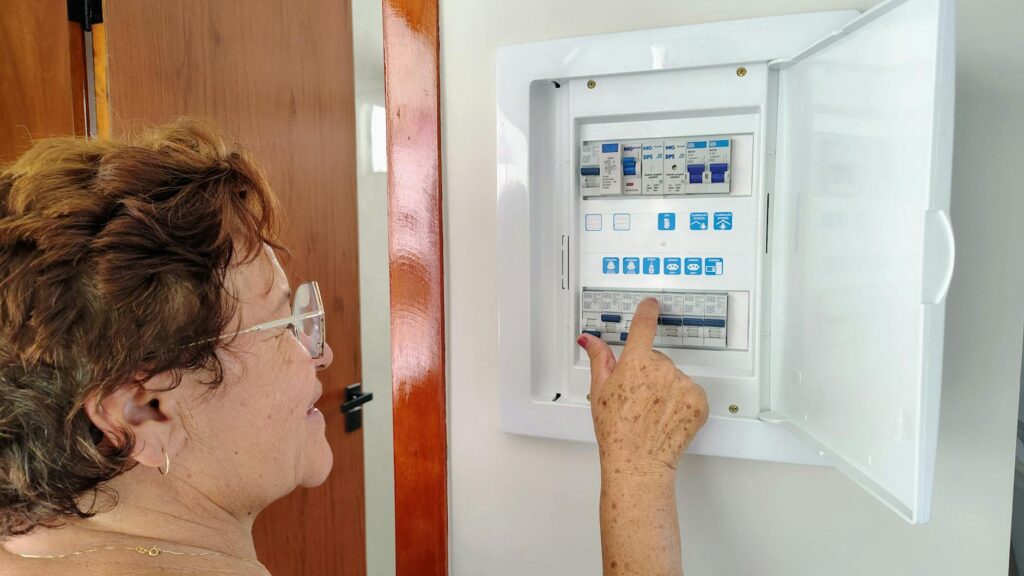
Proper circuit breaker sizing is one of the most critical tasks in electrical system design and installation. An undersized breaker won’t provide adequate protection, while an oversized breaker can allow dangerous overcurrents to damage wiring and create fire hazards. In this guide, I’ll walk you through the exact methodology for sizing circuit breakers correctly, using real-world examples and National Electrical Code (NEC) standards.
Understanding Circuit Breaker Fundamentals
A circuit breaker is an automatic switch designed to protect an electrical circuit from overcurrent caused by overload or short circuit. Unlike fuses, breakers can be reset and reused, making them the standard for modern electrical systems. The breaker’s amperage rating must be carefully matched to both the connected load and the wire gauge of the circuit.
The fundamental principle is straightforward: the circuit breaker must protect the wire, not the equipment. This means the breaker rating should never exceed the ampacity of the smallest wire in the circuit. According to NEC Article 210.19, branch circuit conductors must have an ampacity not less than the maximum load to be served, plus an additional safety margin.
Circuit breaker sizes are standardized in increments: 15A, 20A, 30A, 40A, 50A, 60A, 70A, 80A, 90A, 100A, 110A, 125A, and larger ratings. Most residential applications use 15A or 20A breakers, while larger appliances and industrial equipment may require breakers rated 50A or higher.
Step-by-Step Sizing Methodology
Sizing a circuit breaker requires three essential steps: calculating the total load, determining wire size requirements, and selecting the appropriate breaker rating.
- Calculate the Total Load in Watts or Amps
Begin by identifying all equipment and devices on the circuit. If the load is given in watts, convert to amperes using the formula: Amps = Watts ÷ Volts. For a 120V circuit with a 1,200-watt load, the current is 1,200 ÷ 120 = 10 amps.
For motors and inductive loads, use the full-load current listed on the equipment nameplate rather than calculating from watts alone. Motors have inrush currents that exceed running current, and the NEC provides specific tables for motor circuit protection in Article 430.
- Apply the 125% Safety Factor
The NEC requires that continuous loads (those operating for more than three hours) be calculated at 125% of their rated current. Multiply your calculated load by 1.25. If your circuit will carry a continuous load of 10 amps, the design requirement becomes 10 × 1.25 = 12.5 amps.
For non-continuous loads, you may use the load as calculated without the 125% multiplier, though best practice often applies it anyway for safety margin.
- Select the Wire Gauge
The next step is determining the appropriate wire size based on the calculated load and circuit length. Copper wire ampacities at 60°C (per NEC Table 310.15) are approximately: #14 AWG = 15A, #12 AWG = 20A, #10 AWG = 30A, #8 AWG = 40A, #6 AWG = 55A, #4 AWG = 70A, and #2 AWG = 95A.
Always consult the ampacity tables for your specific wire type and insulation rating. The selected wire ampacity must be equal to or greater than your 125% load calculation.
- Choose the Breaker Rating
Select the breaker rating that matches or is the next standard size below the wire ampacity. Never install a breaker larger than the wire’s ampacity. If your design load (with 125% applied) is 12.5 amps and you’ve selected #12 AWG wire (20A capacity), you should install a 20A breaker—not a 25A breaker (which doesn’t exist as a standard size anyway).
Practical Worked Example: Kitchen Countertop Circuit
Let’s work through a real-world example. You’re installing a kitchen countertop circuit that will serve multiple small appliances. The expected load includes a toaster (1,500W), microwave (1,200W), and coffee maker (900W). However, they won’t all run simultaneously; the maximum expected concurrent load is 2,400 watts.
Step 1: Calculate the Load
At 120V: 2,400W ÷ 120V = 20 amps
Step 2: Apply the 125% Factor
20 amps × 1.25 = 25 amps
Step 3: Select Wire Size
You need a wire ampacity of at least 25 amps. Consulting NEC Table 310.15, #12 AWG copper wire is rated at 20 amps, which is insufficient. #10 AWG copper wire is rated at 30 amps, which exceeds our requirement. Select #10 AWG.
Step 4: Choose the Breaker
The wire ampacity is 30 amps. The largest standard breaker that doesn’t exceed this is 30A. However, since our design load was 25 amps, a 20A breaker would technically work—but a 30A breaker provides better protection for future loads while respecting the wire ampacity. In practice, many electricians would install a 20A breaker for this specific load. The critical rule: never exceed 30A (the wire rating).
If you’re unsure about your load calculations or wire selections, our wire gauge calculator can help verify your choices before installation.
Common Sizing Mistakes to Avoid
One frequent error is oversizing breakers to reduce nuisance trips. If a breaker trips repeatedly, the solution is not to install a larger breaker—it’s to investigate the actual load and potentially add a dedicated circuit. Oversizing creates serious fire risk.
Another mistake involves ignoring voltage drop on long runs. While voltage drop doesn’t directly affect breaker sizing, it may require upsizing the wire, which then determines your breaker rating. Always calculate voltage drop for circuits exceeding 50 feet.
Don’t confuse breaker ratings with equipment ratings either. A 30A breaker protects the wire, not the microwave connected to that circuit. If your microwave is rated for 20A maximum, a 30A breaker is still acceptable—it just means the circuit wire can handle more current than the microwave requires.
Frequently Asked Questions
Can I use a 20A breaker on #14 AWG wire?
No. According to NEC Article 210.19, #14 AWG wire has a maximum ampacity of 15A. Installing a 20A breaker on #14 wire violates the NEC and creates a serious fire hazard. The breaker must never exceed the wire’s ampacity. If you need a 20A circuit, you must use #12 AWG wire minimum.
What’s the difference between a single-pole and double-pole breaker?
A single-pole breaker controls one 120V circuit, commonly used in residential applications. A double-pole breaker controls two 120V circuits or one 240V circuit, typically for larger loads like electric water heaters or HVAC systems. Both are sized using the same methodology—match the breaker rating to the wire ampacity.
How do I size a breaker for a 240V circuit?
The methodology is identical. Calculate your load in watts, divide by 240V to get amperage, apply the 125% safety factor for continuous loads, select appropriate wire gauge from the ampacity tables, and choose your breaker rating accordingly. A 5,000-watt electric dryer at 240V requires 5,000 ÷ 240 = 20.8 amps, rounded up to 21 amps. With 125% applied: 21 × 1.25 = 26.25 amps. You’d select #8 AWG wire (40A capacity) and install a 30A or 40A breaker depending on exact requirements and future load considerations.
Conclusion
Sizing a circuit breaker correctly protects both your electrical system and your building’s occupants. By following the three-step process—calculating load, applying safety factors per NEC standards, and matching breaker ratings to wire ampacity—you’ll ensure safe, code-compliant installations. Remember: the breaker protects the wire first and foremost. When in doubt, consult the NEC directly or engage a electrical writer. Proper sizing takes only minutes but prevents hazards that could take years to manifest as problems.
- Digital Multimeter with Clamp Meter — Essential tool for measuring current and voltage when sizing circuit breakers, directly supports the technical work described in the guide
- Circuit Breaker Sizing Calculator or Electrical Reference Manual — Complements the step-by-step guide with official electrical code references and calculation tools needed for proper breaker sizing
- Thermal Imaging Camera — Helps electricians and homeowners identify overheating circuits and verify proper breaker sizing installation for safety verification
Related reading: What Size Breaker Do I Need for 120 Volts: A Complete Guide.
Related: How to Add a Circuit to Your Panel: Step-by-Step Safety Guide
SPONSORED
Estimating Software Built for Electrical Contractors
ArcSite lets you draw site plans, create estimates, and close jobs faster — all from your phone or tablet. Used by 100,000+ field service professionals.
Try ArcSite Free →Affiliate partner — we may earn a commission at no cost to you.