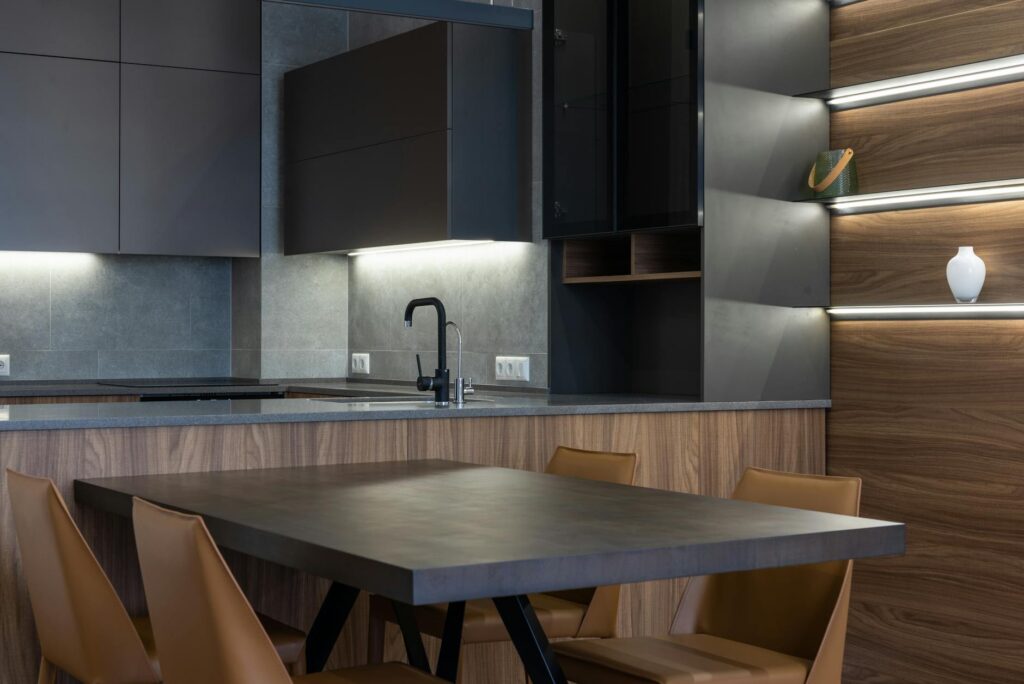
Under-cabinet lighting transforms kitchen functionality and ambiance, but it requires proper circuit design to operate safely and reliably. Most under-cabinet LED installations draw 1–3 amps and run on 14 AWG wire on a 15-amp circuit, though higher-wattage halogen or incandescent fixtures may need 12 AWG wire and dedicated 20-amp circuits. Understanding amperage requirements, wire gauge selection, and switch control options ensures your installation meets the National Electrical Code and performs as intended.
Amperage Requirements and Circuit Sizing
Under-cabinet lighting amperage depends entirely on the fixture type and total wattage. Here’s how to calculate what your installation needs:
LED Under-Cabinet Lights (Most Common)
Modern LED under-cabinet strips consume 8–15 watts per linear foot. A typical 8-foot kitchen setup (two 4-foot runs) draws 16–30 watts total, which equals roughly 0.13–0.25 amps at 120V. This minimal draw means multiple LED installations can share a 15-amp general lighting circuit without overload.
Rule of thumb: You can install 8–10 separate LED under-cabinet systems on a single 15-amp circuit, assuming no other loads.
Halogen and Incandescent Under-Cabinet Fixtures
These older technologies consume 20–50 watts per linear foot. A single 4-foot halogen run draws 80–200 watts (0.67–1.67 amps). If your kitchen has multiple halogen runs or mixed fixture types, you’re pushing toward the 15-amp limit faster. Two or three full-length halogen runs should have their own dedicated 15-amp circuit or share only with minimal other loads.
Calculating Your Specific Load
Use this formula:
Amps = Total Watts ÷ 120V
For example: 60 watts ÷ 120V = 0.5 amps. Size your circuit breaker to handle the total amps, plus a 20% safety margin. A 60-watt load needs a minimum 15-amp breaker; a 180-watt load should use a 20-amp circuit.
Wire Gauge Selection for Safety and Code Compliance
Wire gauge—measured in AWG (American Wire Gauge)—must match both your circuit breaker amperage and the distance from breaker to fixture.
Standard Gauge Selections
14 AWG Wire: Protects a 15-amp circuit and handles 1,440 watts at 120V. This is the minimum for most under-cabinet LED installations. Runs longer than 50 feet may experience voltage drop; keep 14 AWG runs under 50 feet whenever possible.
12 AWG Wire: Required for 20-amp circuits and handles 2,400 watts at 120V. Use 12 AWG if your under-cabinet system exceeds 15 amps, draws more than 1,440 watts, or runs more than 50 feet from the breaker panel. Many electricians prefer 12 AWG for under-cabinet work because it provides headroom for future upgrades and reduces voltage drop over longer distances.
Voltage Drop Considerations
Voltage drop occurs over long wire runs and dims your fixtures. The NEC allows maximum 3% drop on branch circuits. For a 60-foot run pulling 2 amps on 14 AWG wire, voltage drop reaches approximately 2.4%, which is acceptable. For 4 amps on the same wire length, drop climbs to 4.8%—over the limit. In kitchens with peninsula islands far from the breaker panel, 12 AWG is the practical choice.
Cable Type Requirements
Under-cabinet fixtures inside cabinets or installed in wet kitchen areas must use appropriate cable:
- Romex (NM-B): Acceptable for dry locations inside cabinets when run through framing.
- THHN/THWN: Individual conductors in conduit—best for exposed runs and wet locations near sinks.
- Flex conduit: Protects wire from physical damage and moisture in high-splash zones.
Switch Control Strategies and Wiring
How you control under-cabinet lights affects convenience, energy efficiency, and code compliance.
Single-Location Control
The simplest setup runs a 2-wire circuit (hot and neutral) from a wall switch to under-cabinet fixtures. The switch cuts power to all lights simultaneously. This works well for small kitchens with one lighting zone. A single-pole switch is adequate; use standard 15-amp rated switches for 15-amp circuits and 20-amp switches for 20-amp circuits.
Multi-Location Control
Kitchens with island seating or breakfast nooks benefit from three-way switches, allowing control from multiple locations. Run 3-wire cable (hot, neutral, traveler, and ground) between the two switch locations. This requires slightly more complex wiring but follows straightforward NEC guidelines. Code requires switch boxes be accessible and rated for the circuit amperage.
Dimmer Switches
LED under-cabinet lights can use compatible dimmers—but not all LEDs work with all dimmers. Check fixture specifications for dimmer compatibility. Dimmer switches consume wattage, so verify the dimmer’s rated capacity exceeds your total fixture wattage. Install dimmers in accessible wall boxes near the main work area for kitchen task lighting.
Smart and Motion-Sensor Controls
Many modern under-cabinet systems use wireless controls or smart switches. These do not change fundamental wiring requirements but allow convenient scheduling, occupancy sensing, and remote operation. Ensure smart switches are rated for the circuit amperage and compatible with your LED fixtures.
How to Use the Electrical Calc Pro Calculator
Rather than mental math, let the wire gauge calculator do the heavy lifting. Input your total load in watts, circuit distance in feet, and desired voltage, and the tool instantly recommends the correct AWG wire size and flags voltage drop warnings. This eliminates guesswork and ensures code compliance before you buy cable or install conduit.
FAQ
Can I run under-cabinet lights on an existing kitchen circuit?
Yes, if the circuit has available capacity. Calculate the total amps of all connected devices (refrigerator, microwave, outlets, lighting). If adding under-cabinet LEDs (typically 0.25 amps max) keeps you under 12 amps total, you’re safe. However, dedicated circuits are always preferable—they prevent nuisance breaker trips and allow future expansion without overloading.
Do under-cabinet lights require a GFCI outlet or breaker?
Not by NEC code. Under-cabinet lighting circuits are not classified as “countertop outlets” requiring GFCI protection. However, if under-cabinet fixtures are installed within 6 feet of a sink or in wet locations, some jurisdictions recommend GFCI protection as a best practice for safety.
What happens if I use 14 AWG wire on a 20-amp circuit?
This violates the NEC and creates a fire hazard. The 14 AWG wire is rated for 15 amps maximum; a 20-amp breaker will not protect it. If a short circuit occurs, the wire overheats before the breaker trips, potentially causing a fire inside walls or cabinets. Always match wire gauge to breaker amperage—never downsize wire to save money.
Recommended Resources:- Amazon Basics 14 AWG Electrical Wire — Direct match for the wire gauge discussed in the post; essential material for under-cabinet lighting circuit installation
- LED Under-Cabinet Lighting Kit — Practical complement to the electrical guidance; readers installing circuits will need actual fixtures to complete their project
- Digital Multimeter/Amp Clamp Meter — Essential tool for measuring amperage draw and verifying circuit design safety as outlined in the post